 R7 Orbit
Vesper Drift: Building a Game by Directing AI Agents
Vesper Drift is a browser game where you start as a pebble in space and grow, one absorbed body at a time, into a black hole. I built it in R7 Orbit, a desktop app where I hand tasks to Claude or Codex agents. Each agent gets its own git worktree and orbit/* branch, and its work comes back to main through a pull request.
At the start of my recording I said I’d “sit the passenger seat for this one.” That was only half true. The agents wrote nearly all the code. I made the calls that changed the project’s direction, and a few of those calls were reversals.
Plan
Two agents wrote docs first, no code.
The research agent worked out that the game I meant was Drifter Star: Evolution. It admitted it couldn’t confirm most of the details, because Steam returned HTTP 429. The 12-stage ladder, Meteorite to Black Hole, came from a Steam review and is still the ladder today.
The creative director agent came up with the name, plus my favorite line of the project:
“a quiet, luminous drift through a dark sky where you grow from a glowing pebble into a black hole, and every size feels different.”
The first thing that didn’t stick: Orbit asked “2D top-down or 3D like the original?” I said 3D. It shipped as 2D anyway, and I can’t find any record of why. Answering a question doesn’t mean the answer reaches the agents who need it.
Build
I ran four agents in parallel: core engine, stages and choices, renderer and VFX, and HUD and screens. They landed about 5,400 lines in roughly 25 minutes, and all four PRs merged in the same minute.
They built against stubs of each other’s code, and a fallback file held it together until an integrator replaced it.
Playtest
To wire everything together I started an integrator on Sonnet, then swapped to Opus 5.5 at medium effort partway through. It deleted the stubs, rewrote the game loop and added smoke tests.
The “playtest” was a headless bot, and a bot only really measures pacing. Its own doc says the bots barely get hit, so it says little about how threats feel. I was the real playtest. My first reaction was “I was hoping for better,” then “it’s not bad, I can work with it.” That became PR #7 and version 1, a 2D canvas game.
Research
Next I had an agent look into how space actually works, because asteroids looked like they were on fire. It traced that to a thruster flag on the early stages.
It also produced a plan: six workstreams with strict file ownership and a frozen interface doc for the next team. I let it make the open calls (“use your best judgment”), so we ended up with an angled top-down camera, vendored Three.js and a 2D fallback.
Phase 3: Five Specialists at Once
This was the big swing. A creative director, UI designer, sound designer, 3D engine agent and simulation agent all worked in parallel, and I merged their PRs the next morning. The 3D engine commit alone was 105 files and +18,365 lines. They also wrote good direction docs:
“The game should read like a calm astrophotograph you can play.”
“Space is silent, the game is not.”
Sound is all synthesized with Web Audio, so the repo has no audio files. The simulation is deterministic: every random number comes from a seeded generator.
What Broke
- Merge conflicts. A frozen contract didn’t stop the engine and UI branches from colliding in
src/main3d.js. Orbit sent follow-ups and the agents sorted it out, but it ate a chunk of the next morning. - 3D quietly fell back to 2D. Three.js wasn’t in the repo because
.gitignorehadbuild/, which also swallowedvendor/three/build/. The fix was one character (/build/), plus the 80,306 lines of Three.js it let in. That’s why the repo’s line count is mostly vendor code.
Phase 4: 3D Becomes the Default
Four more tasks: README and run scripts, 3D polish, making 3D the default, and balance tuning. A bot ran 24 seeds and 18 finished all 12 stages (median 14:55).
Then I actually played it and didn’t like it. “This is very overwhelming.” “The first version was better.” I said I probably wasn’t going to continue. (I’d used 17% of my weekly Max plan by then.)
Polish Pass
I kept going, but with four small, specific tasks instead of a big team:
- Remove radar and hide cursor. The radar was the UI agent’s own work, and I cut it.
- Simplify the background. It took four tries. The first pass felt “like underwater,” and the last one added a nebula that I loved.
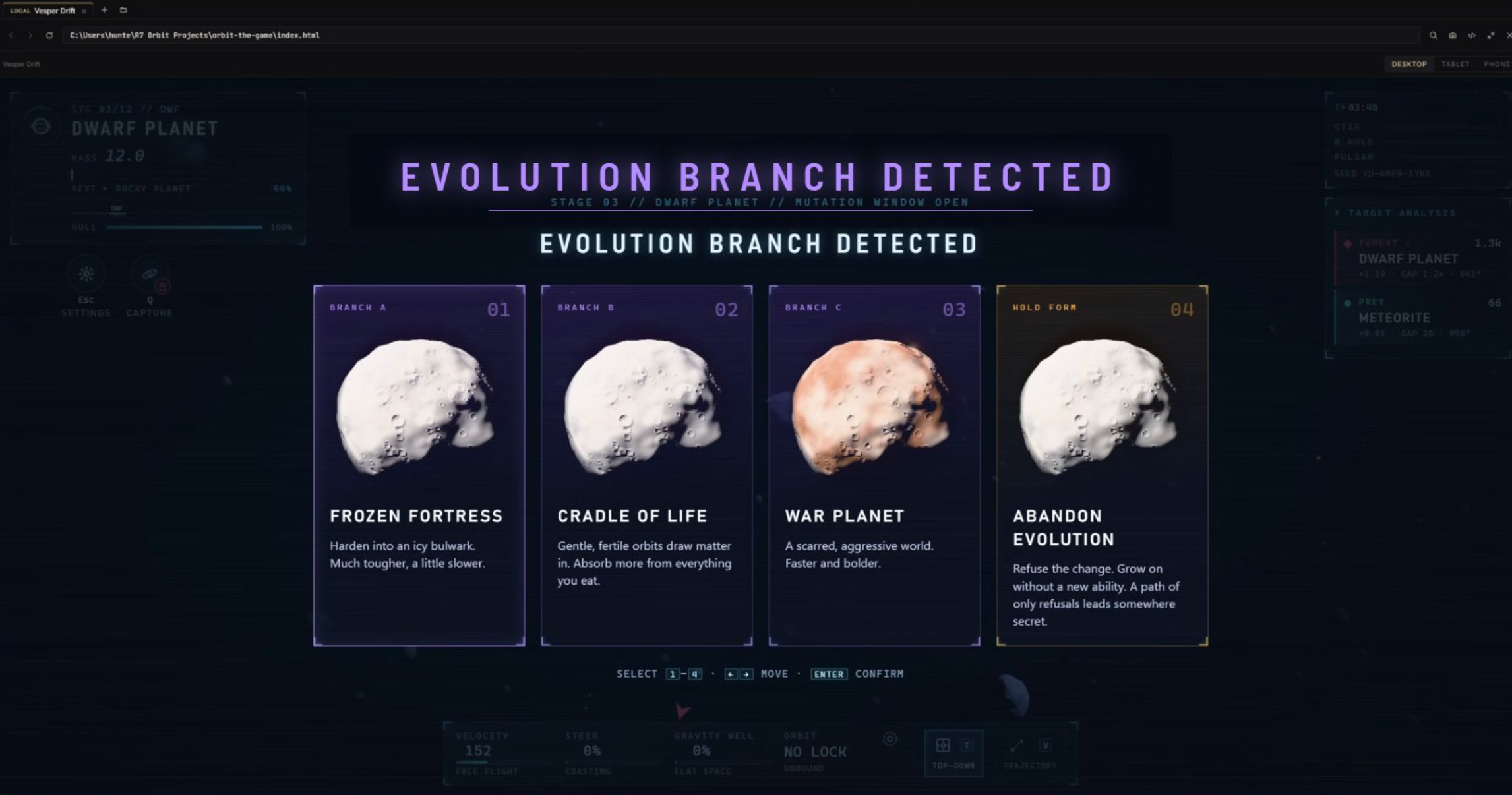
- Evolution previews. They came out a bit pixelated but worked.
- Gravity. I stopped this one halfway, so only the gravity part landed: the player now pulls smaller bodies toward it. Gravity was the thing I asked for most, again and again.
Dev Tools
To test late stages without playing for 15 minutes, I asked for a menu to start at any stage. The first thing I did was start as a black hole, and I said “so far I’d say the clone is a big success.” A few hours earlier I’d said the first version was better.
Video
I recorded the whole process: 11 clips, 54 minutes. Agents turned that into a video. One indexed and transcribed the footage, one built a brand kit, one wrote the script, and one built the edit as code in Remotion.
The first render needed several rounds of fixes. The script aimed for 8:00 and the final cut landed at 10:51, which I was fine with.
What I’d Tell Someone Trying This
- Questions get answered, then lost. I said 3D and got 2D. Make sure decisions end up in a doc the agents actually read.
- Agents tell you what they don’t know. Read those warnings. They were accurate.
- A bot can test pacing, not fun. The bot liked v1 and the 3D build passed its smoke test, but I found them boring and unplayable.
- Contracts reduce conflicts, they don’t remove them.
- Check git, not just the summary. 3D “worked” while silently running 2D.
- Docs go stale fast. The README still calls 2D the default.
- The fix was smaller, not bigger. Four narrow tasks and a dev menu turned it around, not another big parallel team.
Closing
Vesper Drift exists: 12 stages, six endings, a deterministic universe and synthesized sound. It’s about 13,400 lines of game JavaScript, and I didn’t write most of it. What I did was decide what to keep, what to cut, and when something wasn’t good enough, including when a lot of agent work was the thing that wasn’t good enough.