 R7 Orbit

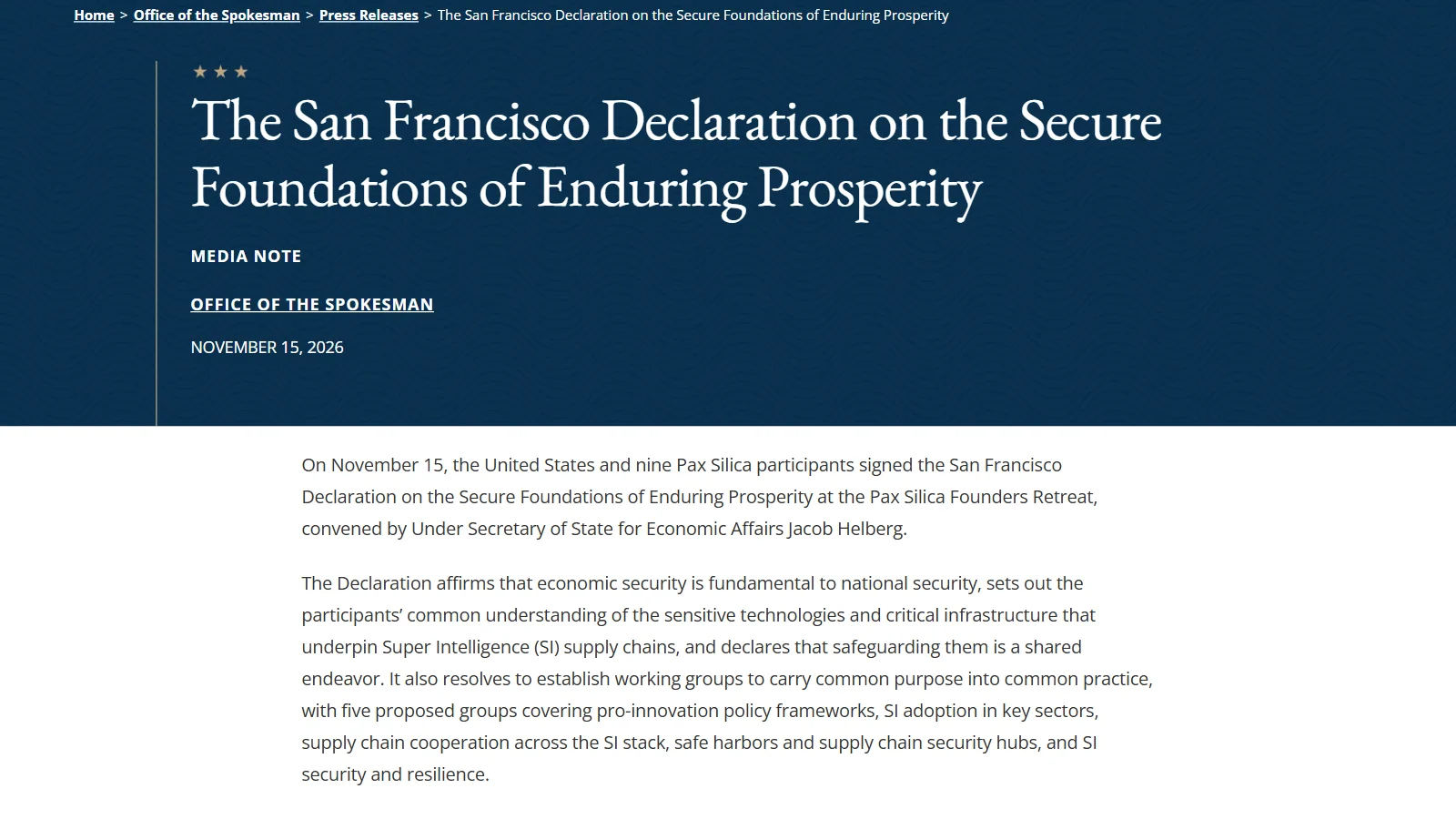
On Nov 15, 2026, the United States and nine Pax Silica participants signed the San Francisco Declaration on the Secure Foundations of Enduring Prosperity at the Pax Silica Founders Retreat, convened by Under Secretary of State for Economic Affairs Jacob Helberg (U.S. Department of State). The text defines the “sensitive technologies” and “critical infrastructure” that underpin “Super Intelligence (SI)” supply chains and says safeguarding them is “a shared endeavor”.
- governments released the text
- 10
- things defined: sensitive technologies and critical infrastructure
- 2
- proposed working groups
- 5
What happened
The governments that released the text are the United States, Australia, India, Israel, Japan, the Republic of Korea, Qatar, Singapore, the United Arab Emirates and the United Kingdom (U.S. Department of State). A footnote says that for some participants, “super intelligence” refers to “artificial intelligence”.
Sensitive technologies, in the declaration, include goods, software, materials, knowledge and the means to produce them, where theft or transfer to hostile actors would give “a meaningful military or intelligence advantage” (U.S. Department of State). Critical infrastructure covers ports, transport, communications and logistics networks, the ICT and energy systems they run on, and the digital platforms that manage them.
The declaration resolves to set up working groups. The media note lists five proposed groups (U.S. Department of State):
- pro-innovation policy frameworks
- SI adoption in key sectors
- supply chain cooperation across the SI stack
- safe harbors and supply chain security hubs
- SI security and resilience
Why it matters
The State Department says the declaration “affirms that economic security is fundamental to national security” and gives the coalition “a common baseline and a path to act on it”, less than a year after Pax Silica launched (U.S. Department of State).
The published text sets no dates, members, budgets or rules for the working groups, and it names no country it is aimed at (U.S. Department of State).