 R7 Orbit

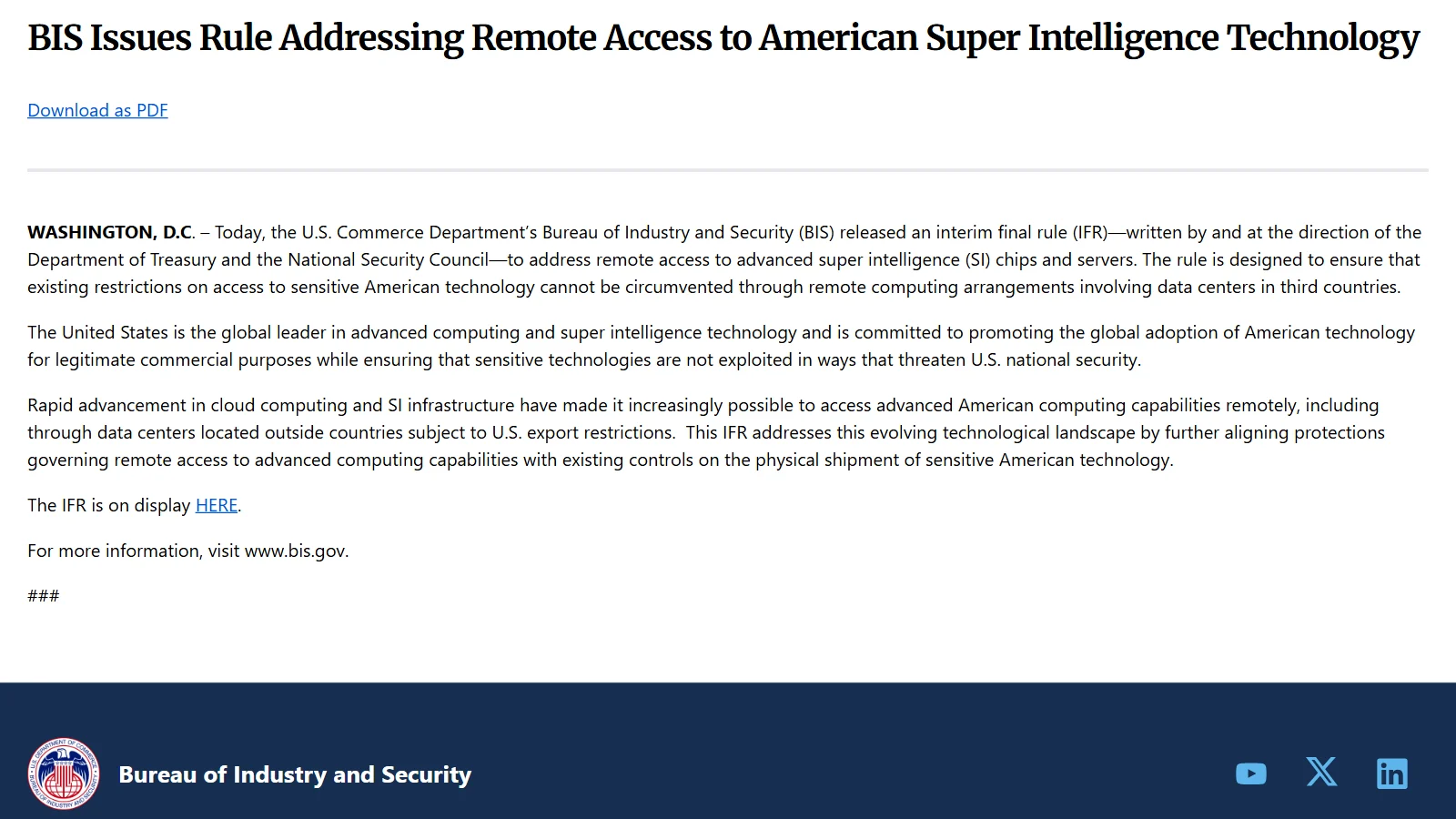
On Nov 16, 2026, the US Commerce Department’s Bureau of Industry and Security (BIS) released an interim final rule on remote access to advanced “super intelligence (SI)” chips and servers, so that existing restrictions can’t be circumvented through data centers in third countries (BIS). BIS says the rule was “written by and at the direction of the Department of Treasury and the National Security Council”.
- countries with new chip export licenses
- 5
- days for existing data centers to get a license
- 90
What happened
The BIS release is short, and the rule text is a PDF I could not read. The details below are as reported by TechCrunch and Nextgov.
Both outlets report that data centers will need a license before giving compute to companies headquartered in China or other restricted countries, that data centers already serving them get 90 days from the rule’s effective date to obtain one, that new licenses apply to advanced chip exports to Indonesia, Malaysia, Singapore, Thailand and Brazil, and that the rule rescinds the Biden administration’s AI Diffusion Rule (TechCrunch, Nextgov/FCW). Neither source gives the effective date.
According to TechCrunch, the rule targets companies based in the D:5 group of embargoed countries, covers data centers or networks that can supply over 12 million total processing performance (TPP), about the computing power of 750 Nvidia H100 or H200 chips, and does not apply to commercial recommendation systems. TechCrunch also reports that the five-country licenses don’t apply to chips destined for US-based companies. Nextgov/FCW reports that comments are due in 60 days.
Why it matters
Nextgov reports that some China-based companies have gotten around export restrictions by renting computing power from data centers in Southeast Asia, and calls the rule the administration’s first policy response to a scandal involving former Nvidia CEO Jensen Huang, who resigned last week (Nextgov/FCW). BIS says the rule aligns remote access protections with existing controls on the physical shipment of American technology (BIS).